
An 8-week GetGrant calendar: 53 calls with deadlines until 31 December 2026 by week and applicant type, key calls for NGOs, businesses, researchers, artists, media, municipalities and students, and how much time to allow for an application.
The end of the year is not a pause in the grant world. Funders close their annual cycles and programmes for 2027 open in the autumn, so November and December become one of the busiest periods for applicants. The GetGrant catalogue currently holds 53 calls with deadlines from 5 November to 31 December 2026, and almost half of them close by 17 November. So the real question is not whether there is somewhere to apply, but what you can realistically prepare well in the time left.
We sorted these calls by deadline week and by applicant type, checked 48 of them against funder websites as of 31 October 2026, and put together an editorial estimate of how long different application formats usually take. At the end you will find a step-by-step plan for the 8 weeks from 4 November to 31 December.
Short answer
- The GetGrant catalogue has 53 calls with deadlines from 5 November to 31 December 2026: 34 in November and 19 in December. Almost half (25) close by 17 November.
- The busiest days are 15–16 November (13 deadlines in two days) and 30 November – 1 December (10 deadlines). After 15 December only 3 calls remain.
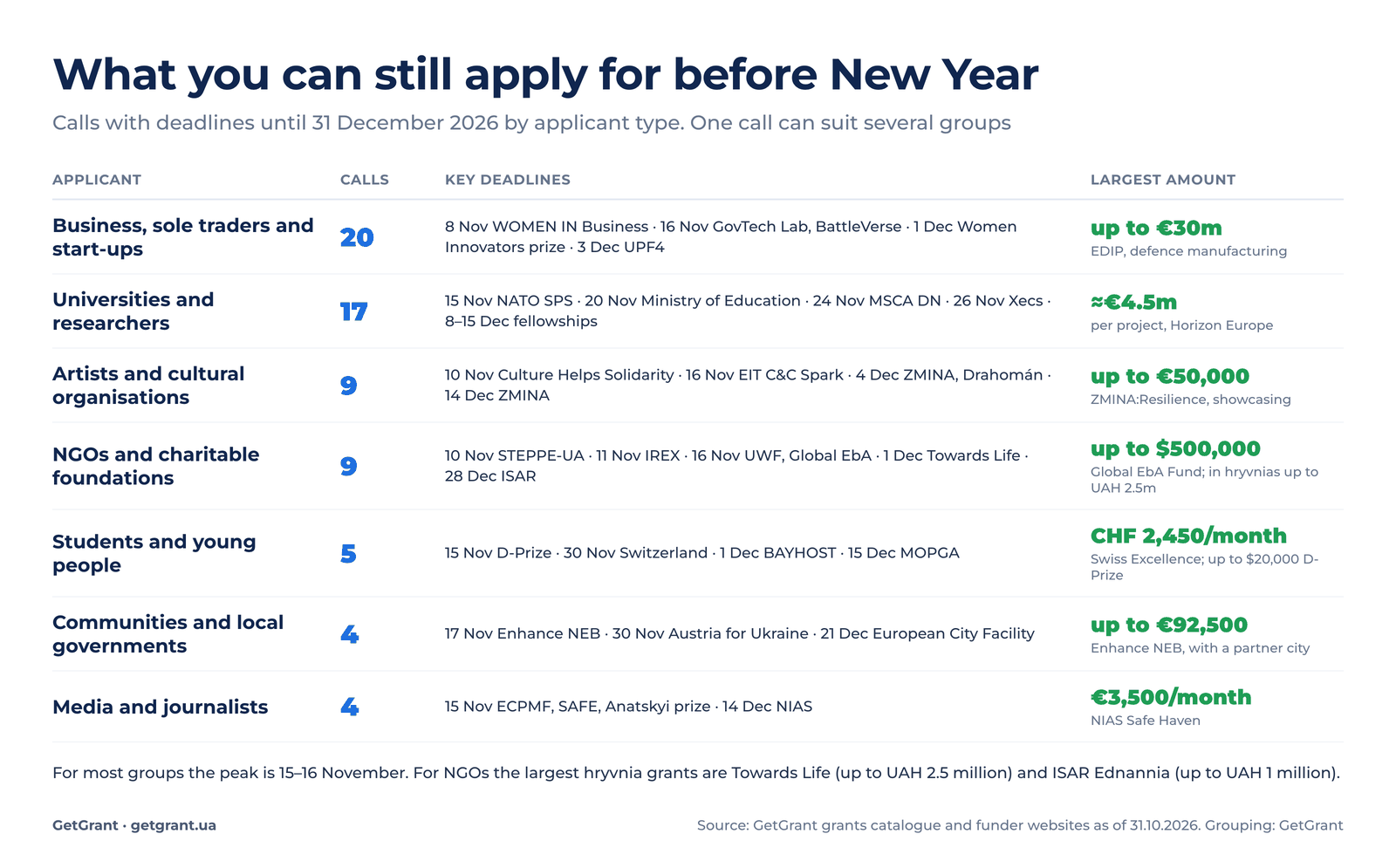
- The largest amounts are for businesses and consortia: up to €30 million per project under EDIP to expand defence manufacturing, €0.5–4 million under the Dutch UPF4 programme (mandatory quick scan by 3 December), and about €4.5 million per project in a Horizon Europe topic on geothermal assessment. For civil society organisations the largest hryvnia grants are up to UAH 2.5 million (Towards Life) and up to UAH 1 million (ISAR Ednannia).
- Most opportunities are for businesses and start-ups (20 calls) and researchers (17), followed by culture and NGOs (9 each), students and young people (5), and communities and media (4 each). One call can suit several groups.
- Starting from scratch, a prize nomination, a scholarship application or a small grant can realistically be prepared in 1–3 weeks. An EU consortium project due by the end of November only makes sense if partners and a draft already exist.
- Check the time zone: “17:00 CET” in November and December means 18:00 Kyiv time, and “12:00 US Eastern time” means 19:00 Kyiv time.
Eight weeks: how the deadlines are spread
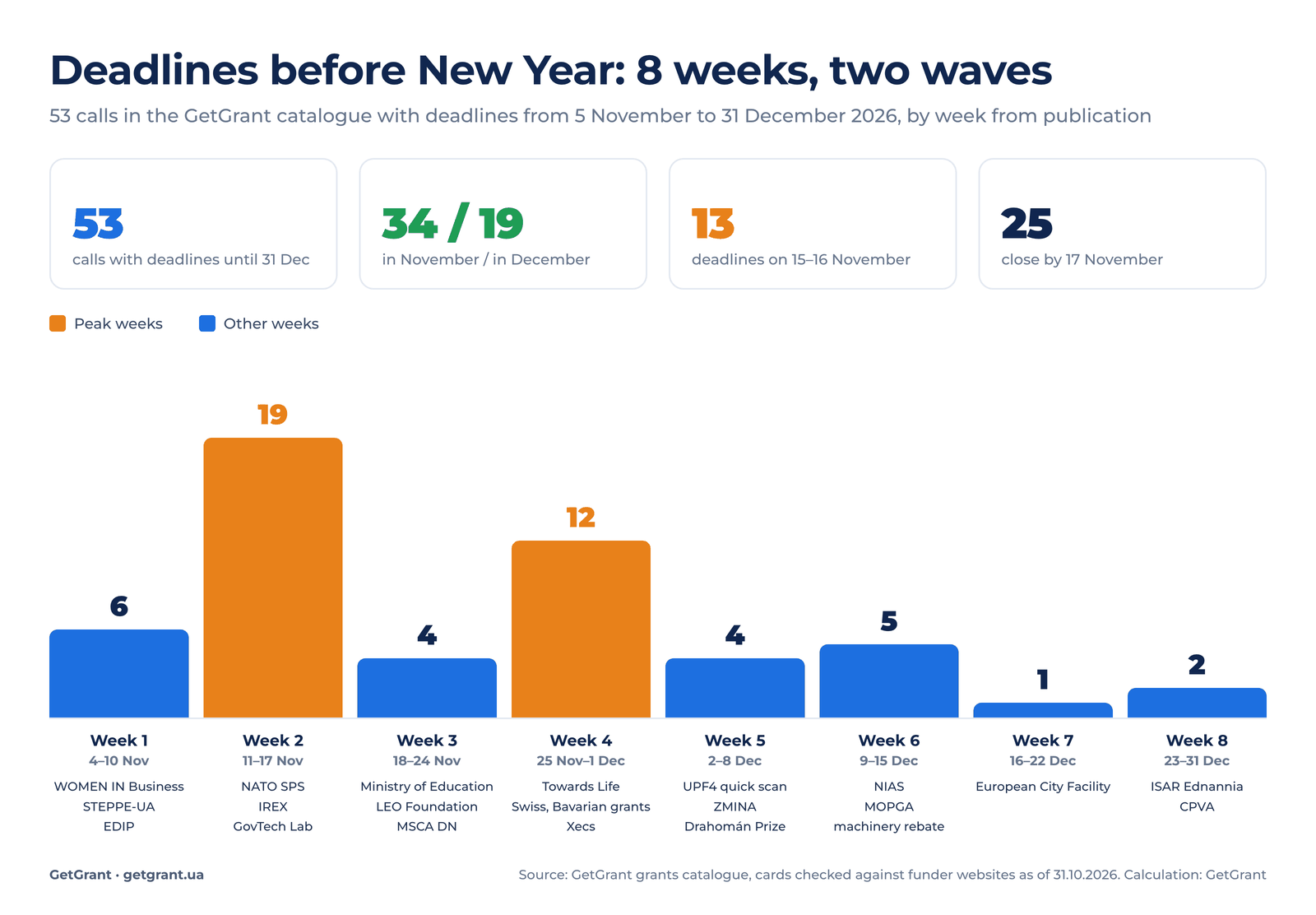
The distribution is uneven, and that matters more than the total. Week two (11–17 November) holds 19 deadlines, every third call: many international programmes close in mid-November, from NATO SPS and ETH Zurich to BattleVerse and GovTech Lab. The second wave is 30 November and 1 December: Swiss and Bavarian scholarships, the prize for women innovators and the Askold and Dir Fund call.
December is calmer and more varied: 19 deadlines, from the women innovators prize and the Dutch UPF4 to fellowships for researchers, cultural calls and state compensation for machinery. After 15 December only three remain: the European City Facility for municipalities (21 December), ISAR Ednannia’s Cooperation Platforms (28 December) and the Lithuanian CPVA business partnership programme (31 December).
Keep in mind that 8 and 15 November fall on a Sunday, so answers from the funder and your director’s signature realistically have to be obtained by Friday. And where applications are reviewed as they arrive, submitting late gives you no advantage.
Who you are and what you can still make
NGOs and charitable foundations
- STEPPE-UA, run by the NGO Desiate Kvitnia with support from Sida: up to UAH 920,000 for capacity building of NGOs in central and southern Ukraine, until 10 November, 23:00. Projects run from December 2026 to June 2027.
- IREX, UVRR programme: up to $100,000 without co-financing for veteran services in the Volyn, Zakarpattia, Zaporizhzhia, Poltava, Cherkasy and Chernivtsi regions, until 11 November, 23:59.
- Ukrainian Women’s Fund: up to €15,000 (paid in hryvnias) for women’s NGOs implementing regional action plans on Resolution 1325 “Women, Peace and Security”, until 16 November, 23:59.
- Global EbA Fund: up to $500,000 for projects of up to 24 months on ecosystem-based adaptation to climate change, until 16 November. The project must build on existing work, so this call is for organisations with a track record in the field.
- Towards Life: Country in Action by the Askold and Dir Fund (administered by ISAR Ednannia): up to UAH 2.5 million for national civil society organisations developing systemic recovery solutions. The second sub-wave closes on 1 December, 17:00, questions until 24 November.
- Civil Society Cooperation Platforms by ISAR Ednannia: up to UAH 1 million, applications until 28 December. Proposals are assessed as they arrive, so there is no point waiting until the end of December.
Businesses, sole traders and start-ups
- WOMEN IN Business 2026 by UKRSIBBANK: a main grant of UAH 200,000 and two of UAH 150,000 for women entrepreneurs, applications until 8 November inclusive, online pitching of finalists on 1 December.
- GovTech Lab Ukraine 2.0: up to $100,000 to pilot a digital solution for the Ministry of Digital Transformation, the State Space Agency, the National Agency on Corruption Prevention or the Ministry of Culture, until 16 November, 23:59 Kyiv time.
- BattleVerse (European Defence Fund): up to €60,000 per company and up to €180,000 per experiment with AI, simulations and drone swarms. Ukraine is named among the eligible countries, deadline 16 November, 17:00 CET.
- EIT Urban Mobility SME Market Expansion: a fixed €60,000 for SMEs taking a proven urban mobility solution to new markets, about 10 projects, until 1 December, 17:00 CET.
- European Prize for Women Innovators (EIC and EIT): up to €100,000 for founders of innovative companies and up to €50,000 in the under-35 category, until 1 December.
- Ukraine Partnership Facility (UPF4): from €500,000 to €4 million, up to 90% of eligible costs, for projects with a Dutch partner in healthcare, water, sustainable energy and agrifood. A mandatory quick scan must be submitted by 3 December, and the application itself from 4 March to 8 April 2027.
For defence manufacturers, the EDIP topic offers up to €30 million per project (minimum budget €2 million) until 10 November. Among state instruments there is 30% compensation for energy equipment in Bukovyna until 27 November and 25% compensation for Ukrainian-made machinery (40% for frontline farms): claims for machinery bought this year must be filed by 10 December.
Universities and researchers
- NATO Science for Peace and Security: joint projects of researchers from Ukraine and NATO countries, typically about €400,000 over 36 months, until 15 November, 23:59 CET.
- Ministry of Education and Science, business-commissioned research: the state covers up to 65% of the cost of a project by a state university or research institution if the customer is a small business (up to 60% for a medium-sized one, up to 50% for a large one). Documents until 20 November, 17:00.
- LEO Foundation: DKK 2–4 million for dermatology research, until 23 November, 16:00 CET.
- MSCA Doctoral Networks 2026: international doctoral programmes run by consortia of at least three organisations from three countries, deadline 24 November.
- Xecs Quantum Call (Eureka): a quantum technology project outline by 26 November, 17:00 CET, and a full proposal by 5 March 2027. The Ministry of Education and Science funds Ukrainian participants with up to UAH 199,000 a year.
- World Cancer Research Fund: up to £500,000 over 4 years for cancer prevention research; only a letter of intent is due by 13 November.
For individual researchers, December brings fellowships: the Harvard Bell Fellowship ($75,000 a year, until 8 December), the NIAS Safe Haven Fellowship (€3,500 a month, until 14 December) and MOPGA in France (12 months for early-career climate researchers, until 15 December).
Artists and cultural organisations
- Culture Helps Solidarity by the European Cultural Foundation: up to €30,000 for a partnership between a Ukrainian organisation and one from a Creative Europe country, until 10 November, 14:00 Kyiv time.
- EIT Culture & Creativity Spark: up to €30,000 without co-financing and nine months of incubation for teams with a tech idea in fashion and architecture that have not yet registered a company, until 16 November, 17:00 CET.
- Mykola Anatskyi Prize of the State Agency for Arts and Art Education: UAH 20,000 for documentary or art photography, nominations and self-nominations until 15 November.
- ZMINA:Resilience, co-creation: up to €25,000 and up to 90% of costs for international projects, legal entities only, application in English, until 4 December, 23:59.
- Drahomán Prize: €3,000 for translators from Ukrainian, nominations until 4 December.
- ZMINA:Resilience, showcasing: up to €50,000 to present Ukrainian art projects in Europe, round deadline 14 December. Those who miss it have three more rounds: 15 March, 14 June and 15 October 2027.
Media and journalists
- ECPMF and MFRR Journalists-in-Residence: free housing in Leipzig, €1,000 a month, insurance and travel for journalists under pressure, residencies in 2027, applications until 15 November.
- SAFE Psychological Support Fund: up to €500 for psychotherapy or psychological support for journalists and media workers, applications reviewed on a rolling basis until 15 November, services to be completed by 31 December 2026.
- The NIAS Safe Haven Fellowship is also open to journalists, writers and artists at risk, until 14 December. Photojournalists should also look at the Anatskyi Prize in the documentary photography category.
Communities and local governments
- Enhance NEB 2027 by EIT Urban Mobility: up to €92,500 per project for a consortium with a partner city, €370,000 in total for 4 projects. The call scales solutions from earlier Connect NEB and Co-create NEB projects, deadline 17 November, 17:00 CET.
- Municipal Exchange Fund “Austria for Ukraine”: €25,000–50,000 for a joint project of a Ukrainian and an Austrian municipality lasting 6–8 months, until 30 November.
- European City Facility, Call 8: a fixed €60,000 to develop an investment concept for energy efficiency and clean energy, until 21 December, 17:00 Brussels time.
Students and young people
- Swiss Government Excellence Scholarships: CHF 2,450 a month for a research fellowship or a PhD, for applicants born after 31 December 1991, applications from Ukraine until 30 November.
- BAYHOST: €992 a month for a master’s degree or research in Bavaria, first-time applications until 1 December.
- D-Prize: up to $20,000 to launch a social venture that distributes an already proven solution. Regular deadline 15 November, extension deadline 6 December.
- MOPGA also suits young researchers who defended their PhD in or after December 2021, until 15 December.
How much time you need to prepare
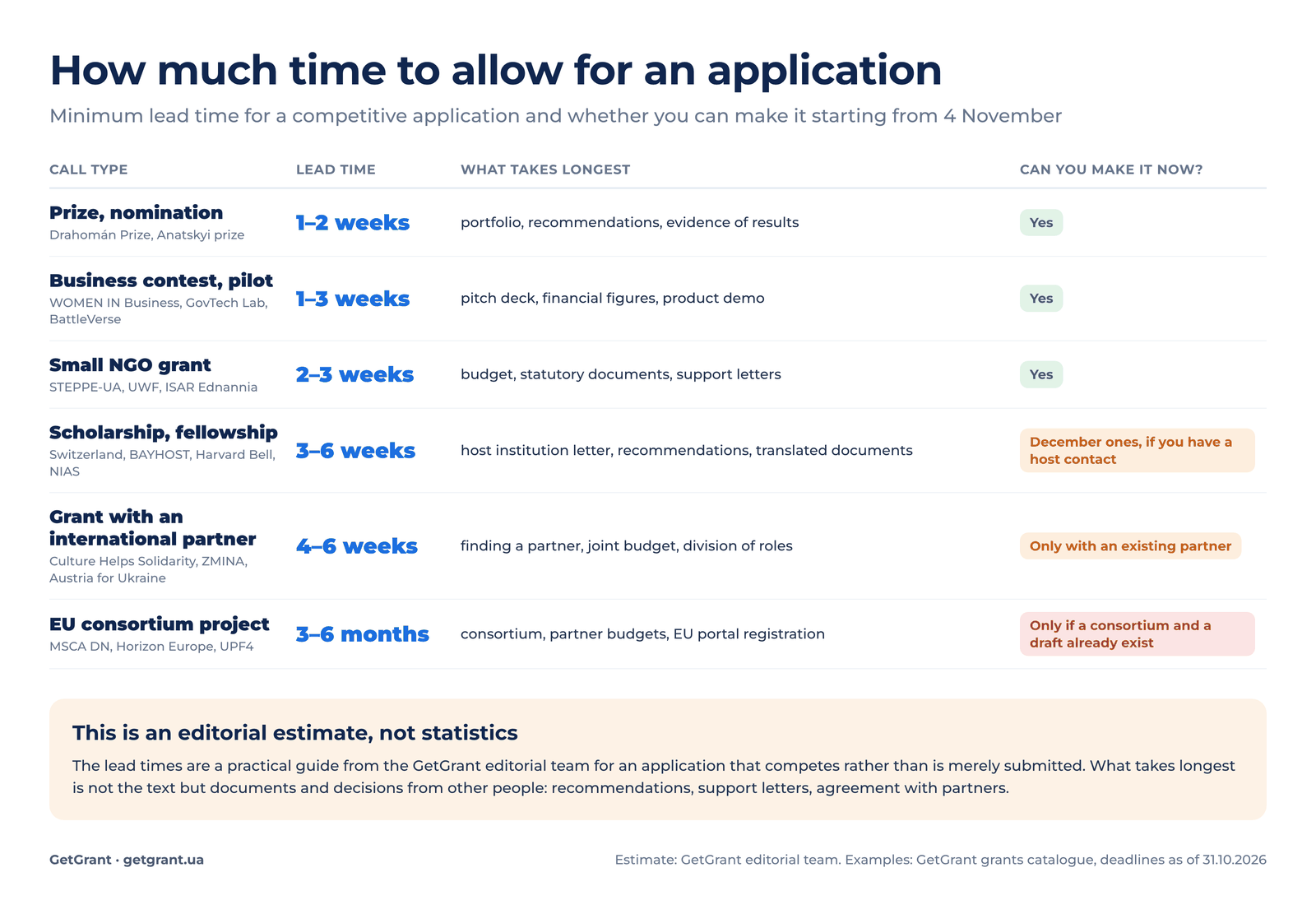
This is not statistics but a practical estimate by our editorial team: how much time to allow for a competitive application. What takes longest is not the text but dependence on other people. For a prize it is recommendations and a portfolio, for a scholarship the host institution’s letter, for an NGO grant the budget and support letters from the authorities, and for an EU consortium project agreeing roles and budgets with partners from several countries.
Hence a selection rule: if the deadline is less than two weeks away, apply only where you control all external documents yourself. If you have four weeks or more, you can take on a grant with partners, but agreements with them should be settled in the first week.
An 8-week plan
- Week 1 (4–10 November). Choose 2–3 calls that fit your profile and submit what is almost ready. For the 15–16 November calls, send your questions to the funder and request recommendation letters now.
- Week 2 (11–17 November). The peak: 19 deadlines. Submit 1–2 days before the deadline and, in parallel, start the UPF4 quick scan and talks with partners for the 1 December calls.
- Week 3 (18–24 November). 4 deadlines, including the Ministry of Education and Science and the LEO Foundation. Use the rest of the time on budgets for December applications.
- Week 4 (25 November – 1 December). The second wave: 12 deadlines, from Towards Life to the Swiss and Bavarian scholarships.
- Week 5 (2–8 December). The UPF4 quick scan, ZMINA:Resilience, the Drahomán Prize, Harvard Bell.
- Week 6 (9–15 December). Machinery compensation, NIAS, ZMINA:Resilience showcasing, EIT STEM Tech Talent Induction, MOPGA.
- Week 7 (16–22 December). European City Facility by 21 December, and planning for first-quarter 2027 calls.
- Week 8 (23–31 December). ISAR Ednannia (better not on the last day) and CPVA. Keep all the documents you prepared: you will need them in the spring.
How not to miss a deadline
The simplest protection against rushing is to keep all your chosen calls in one place. In the GetGrant account, opened and tracked calls appear in the deadline calendar, and on the My Grants page the “Deadlines approaching” bar shows those closing within the next 30 days. On paid plans you can also subscribe to auto-search for your areas and receive selections of new grants by email.
If you have a project idea but no specific call, the “Grant for your goal” page in the account can help: you describe the task and the system shows calls that are close in content. This is a list of candidates, not a guarantee of eligibility, so always check the participation rules, applicant country and deadline on the funder’s page, which every catalogue card links to.
Conclusion
You have 53 calls before New Year, but far fewer real chances than deadlines. 25 calls close by 17 November, and for most of them only those who already have a draft, partners and documents will make it. The second wave on 30 November – 1 December and the December fellowships give more time, and ZMINA:Resilience, UPF4 and Xecs already show their 2027 schedules. The best strategy for these 8 weeks is to choose 2–3 calls that fit your profile, submit them without a last-night race and, in parallel, build a base for the spring calls.
The GetGrant team helps you choose a call that fits your situation, check eligibility and prepare the application, budget and supporting documents. Current calls are collected in the GetGrant catalogue, and a tailored selection can be ordered on the services page.
Sources
- GetGrant grants catalogue: cards of calls with deadlines in November–December 2026
- NGO Desiate Kvitnia: STEPPE-UA mini-grants call (in Ukrainian)
- IREX UVRR: grant competition for NGOs on services for veterans in the regions (in Ukrainian)
- Ukrainian Women’s Fund: call to support regional 1325 action plans (in Ukrainian)
- Global EbA Fund: Medium-size grants
- ISAR Ednannia: Towards Life: Country in Action (in Ukrainian)
- ISAR Ednannia: Civil Society Cooperation Platforms (in Ukrainian)
- UKRSIBBANK: WOMEN IN Business 2026 (in Ukrainian)
- Global Government Technology Center Kyiv: GovTech Lab Open Call
- BattleVerse: Open Calls
- EIT: SME Market Expansion Open Call 2027
- RVO: Ukraine Partnership Facility
- Funding & Tenders portal: EDF-EDIP-USI-2026-LS-IRA-MAB, HORIZON-MSCA-2026-DN-01-01, HORIZON-EIC-2026-PRIZE-WIP, HORIZON-CL5-2026-11-D3-06
- Chernivtsi Regional Military Administration: compensation for business energy equipment (in Ukrainian)
- Made in Ukraine: 25% compensation for Ukrainian machinery (in Ukrainian)
- NATO SPS: Call for Proposals 2027-1
- Ministry of Education and Science of Ukraine: call for joint applied research commissioned by business (in Ukrainian)
- LEO Foundation: Research Grants
- Xecs: Calls
- World Cancer Research Fund: Regular Grant Programme
- Harvard Center for Population and Development Studies: Bell Fellowship
- NIAS: Safe Haven Fellowship
- Campus France: MOPGA 2027
- European Cultural Foundation: Culture Helps Solidarity, second call
- EIT Culture & Creativity: New Ventures in Creative Tech (Spark)
- State Agency for Arts and Art Education: Mykola Anatskyi Prize 2027 (in Ukrainian)
- IZOLYATSIA Foundation: ZMINA:Resilience, co-creation
- IZOLYATSIA Foundation: ZMINA:Resilience, showcasing
- PEN Ukraine: Drahomán Prize
- MFRR: Journalists-in-Residence
- ECPMF: SAFE Psychological Support Fund
- EIT Urban Mobility: Enhance NEB 2027
- KDZ: Municipal Exchange Fund “Austria for Ukraine”
- European City Facility: Call 8
- SBFI: Swiss Government Excellence Scholarships, list of European countries and deadlines
- BAYHOST: Study in Bavaria
- D-Prize
- EIT STEM Tech Talent Induction: Call for Proposals 2026

Book a consultation or leave your application idea
Tell us in a few words about your project: we will say which grants it fits and can take the application itself off your hands. We reply within one business day.