The mechanism for exporting Ukrainian weapons to Drone Deal countries has been in force since July, but not a single permit has been issued under it. We look at why this happened, what Defence City status gives and how to build a defence manufacturer's financial model for 2027.
On 1 July 2026 the government adopted a mechanism for the controlled export of Ukrainian weapons to partner countries. Within a few weeks Ukraine had signed Drone Deal agreements with almost a dozen states, and manufacturers gained hope of selling their surplus capacity, which the industry estimates at between half and 60% of production capability. In parallel, the Defence City special regime with tax incentives for defence enterprises has been operating since January.
Three months on, the picture looks different from the announcements. As of 2 October, not a single permit had been issued under the new export mechanism. Defence City, meanwhile, has grown to 51 residents. In this article we look at how both regimes work, why exports are stalling, who benefits from becoming a Defence City resident and how this relates to grants and contracts in the EU. The data were checked against primary sources as of 10 October 2026.
Short answer
- The new export mechanism operates under Cabinet of Ministers Resolution No. 875. It applies for the period of martial law and six months after it, covers Drone Deal partner states and provides for an application to be reviewed within 30 days.
- From every export contract, 20% for finished products and 30% for components must be paid to the special fund of the state budget. Industry associations name these contributions as the main reason the mechanism has not started working.
- The general procedure through the Interagency Commission operates in parallel. Since February 2026 it has considered more than 400 applications, approved more than 90% of them, and more than 18 permits for finished products have been issued.
- Defence City gives exemption from corporate income tax on condition of reinvestment, exemption from land, property and environmental taxes, customs simplifications and a direct export procedure without a separate government decision. The condition: at least 75% of income from the company’s own defence products.
- For most manufacturers, the real source of money for scaling up in 2026–2027 is currently not exports but joint projects with the EU through EDIP and the Ukraine Support Instrument.
How the new export mechanism works
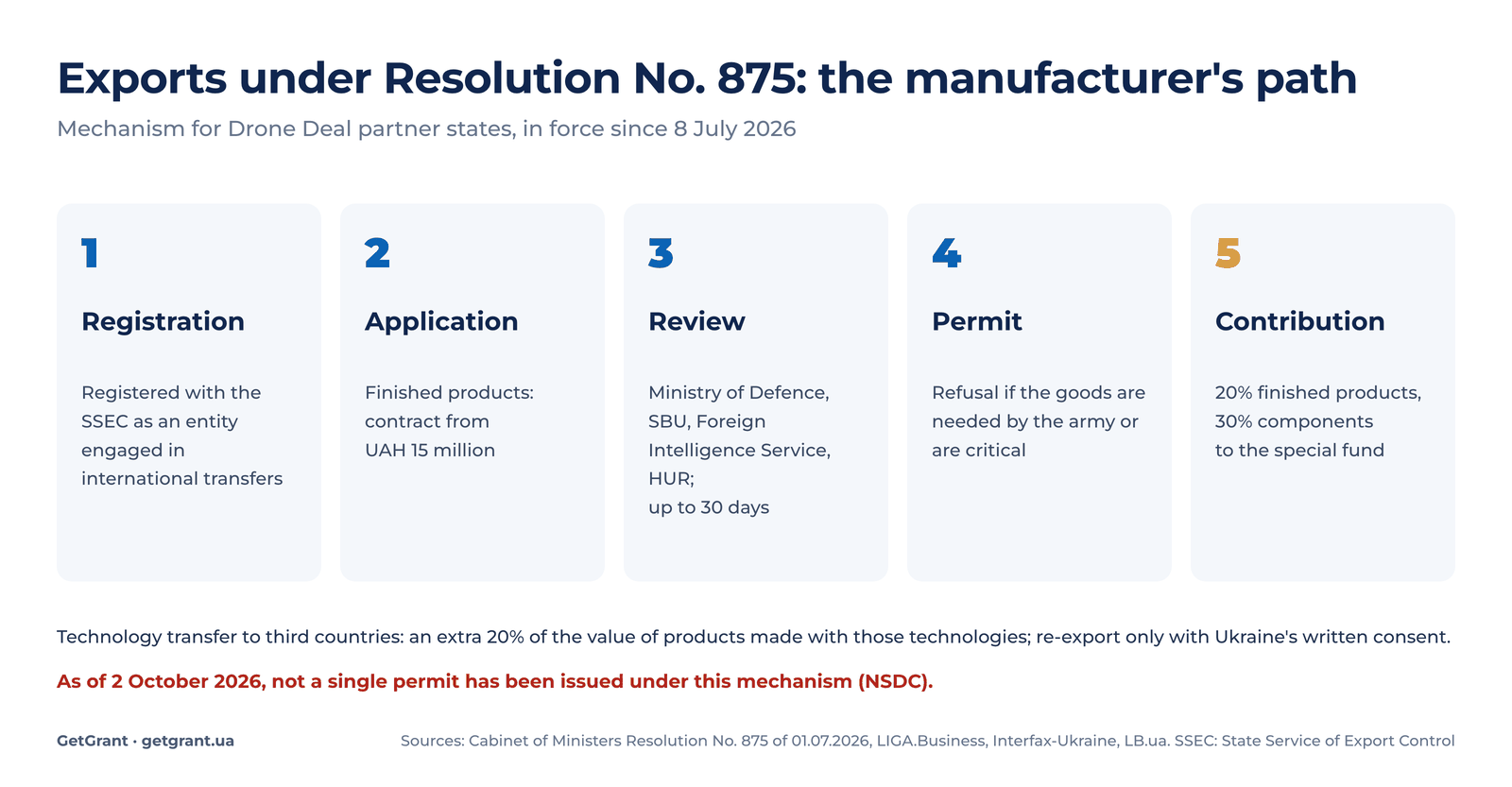
Resolution No. 875 of 1 July 2026 came into force on 8 July. It allows Ukrainian weapons and technologies to be supplied to states with which Ukraine has concluded intergovernmental agreements in the Drone Deal format. Intellectual property rights are not alienated in the process, and re-export is possible only with Ukraine’s written consent.
Key parameters:
- The permit is issued by the State Service of Export Control (SSEC). The manufacturer must be registered with the SSEC in advance as an entity engaged in international transfers.
- The application is reviewed by the Ministry of Defence, the Security Service of Ukraine (SBU), the Foreign Intelligence Service and the Defence Intelligence of Ukraine (HUR). For Drone Deal partner countries a decision of the Interagency Commission is not required unless the case falls into the higher-risk category.
- The minimum contract value for finished products and technologies is UAH 15 million. There is no minimum for components and spare parts.
- The manufacturer must confirm that it is able to fulfil the state defence order and the export contract at the same time.
- The Ministry of Defence updates the list of critical goods whose export is restricted every quarter, and the Ministry of Foreign Affairs maintains the list of states to which export is permitted. The resolution contains seven grounds for refusal and three grounds for suspending a permit.
- 20% of exports of finished products and technologies and 30% of exports of components are directed to the special fund of the state budget for the development of the defence industry. The transfer of technologies to third countries costs an additional 20% of the value of the products manufactured using those technologies.
For comparison: under the general procedure the SSEC had up to 90 days for review, and a permit to start exporting could take months for new exporters.
Who the Drone Deal agreements have been signed with
The President announced the Drone Deal format on 28 April 2026. There is no official consolidated list of countries, so we compiled one from publications in industry media.
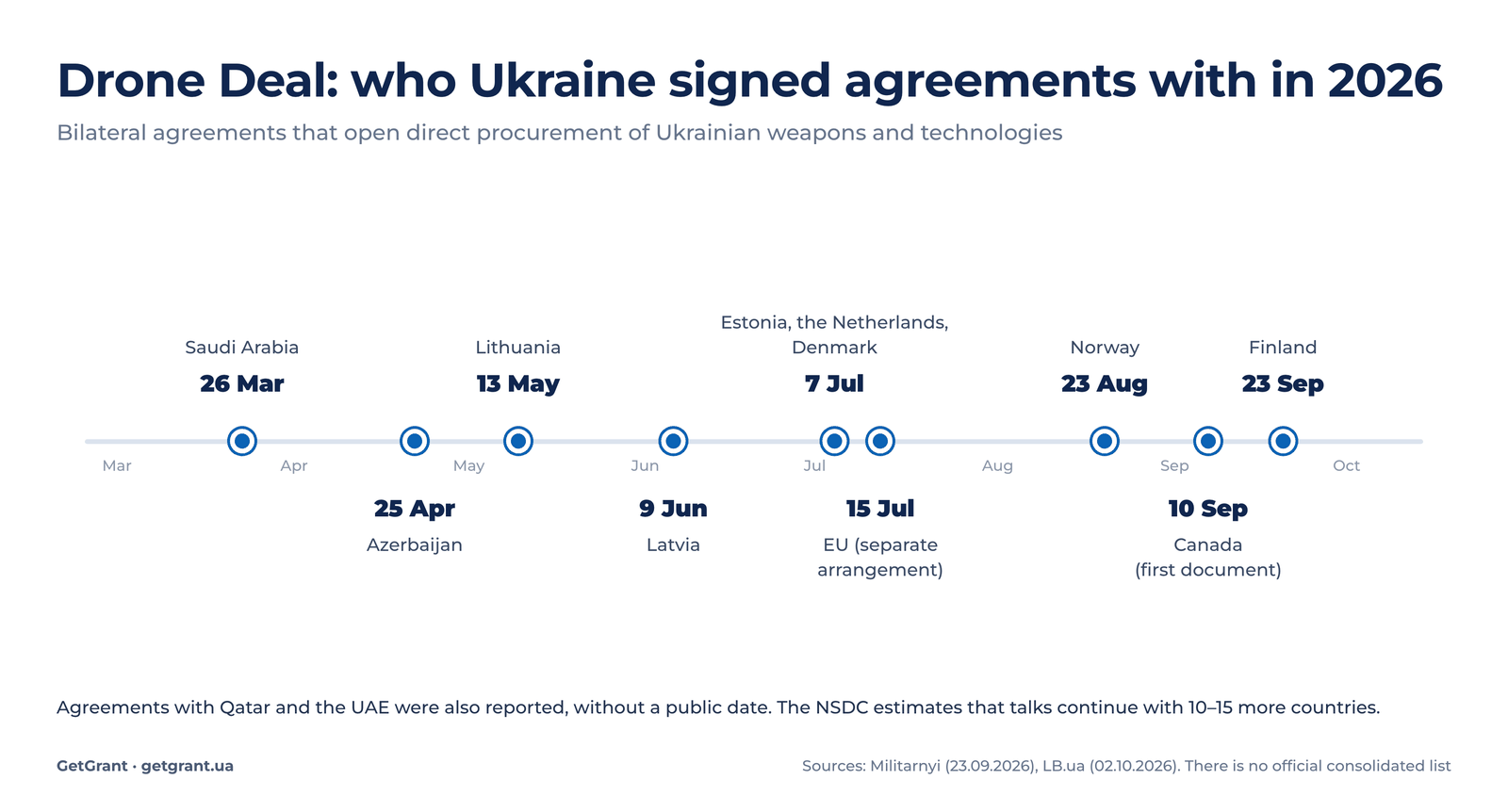
Separately, on 15 July 2026 a Drone Deal arrangement between Ukraine and the EU was announced, and negotiations with the United States are continuing. Davyd Aloian, Deputy Secretary of the National Security and Defence Council (NSDC), said in early October that 10–15 countries are in the process, about five of them at the final stage.
Why the mechanism has not started working
The most important fact for business: in the three months that Resolution No. 875 has been in force, not a single permit has been issued under it. Aloian gives two reasons for this. The Ministry of Defence has not yet approved the final list of critical goods, and the contribution mechanism needs to be changed. The NSDC has already sent the government recommendations on adjusting the resolution.
“I do not think it will work.”
Davyd Aloian, Deputy Secretary of the NSDC, on Resolution No. 875 in its current form, LB.ua, 2 October 2026.
The industry’s position is the same. The National Association of Ukrainian Defence Industries pointed out that the 20 per cent contribution is also applied to contracts under the “Danish model”, where the weapons remain in Ukraine. According to the association’s estimate, projects worth several billion euros are blocked because of this. The Ukrainian Council of Defence Industry (Rada Zbroiariv) and Tech Force in UA are asking for a zero contribution, for payment not to be required before the contract is performed, for the money to be returned if a deal falls through, and for test and pilot deliveries to be simplified. They also report that more than 200 requests from partners under Build with Ukraine have been left without a decision.
Bill No. 15400, which proposed splitting the proceeds from the contributions equally between weapons procurement and military pay, was rejected by the Verkhovna Rada at first reading on 15 September 2026.
At the same time, the general procedure through the Interagency Commission is working. Since February 2026 the commission has held about 11 meetings, considered more than 400 applications and approved more than 90% of them. More than 18 permits for finished products have been issued, and about 80 more applications are awaiting review. In other words, exports exist, but they follow the old route, more slowly and without the preferential regime for partner countries.
Defence City: who benefits from becoming a resident
The Defence City special regime was introduced by Laws No. 4577-IX and No. 4578-IX of 21 August 2025, and it became fully operational on 5 January 2026. The regime is in force until 1 January 2036 or until Ukraine’s accession to the EU, if that happens earlier.
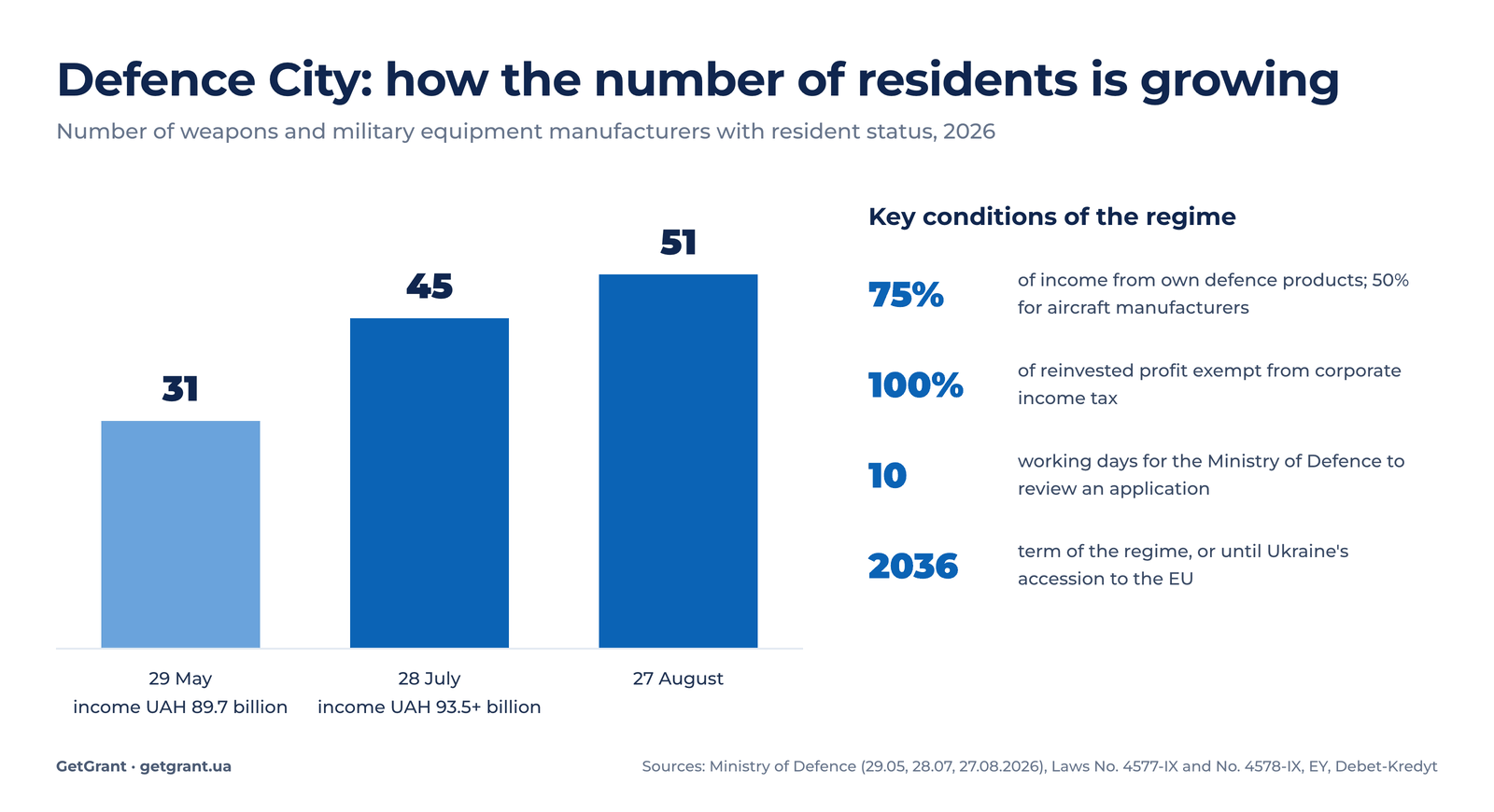
Who can become a resident. An enterprise in which at least 75% of income is qualified income from its own defence products and services, or 50% for aircraft manufacturers. The status is not available to companies registered abroad, those linked to the aggressor state or under sanctions, those that have breached a defence contract in the past 12 months, non-profit organisations, or enterprises with a tax debt of more than 10 minimum wages or located in occupied territories.
What the status gives:
- exemption from corporate income tax for profit reinvested by 31 December of the following year in equipment, modernisation, technologies, research or defence intellectual property;
- exemption from land tax, real estate tax and environmental tax from the month after the status is obtained;
- customs simplifications for importing components for the period of martial law and one year after it;
- the possibility of exporting without a separate government decision under Article 13 of the law on export control, which previously took 6–12 months; registration with the SSEC and a permit for each operation remain mandatory;
- the possibility of obtaining critical enterprise status with reservation from mobilisation of up to 100% of employees.
What you will have to give up. A resident cannot pay dividends, except to the state, and cannot use Diia City benefits at the same time. Every year a compliance report must be submitted with an audit by an auditor entitled to audit public interest entities. The Ministry of Defence monitors how the tax-exempt profit is used.
“Defence City is becoming one of the systemic instruments for developing the Ukrainian defence industry.”
Hanna Hvozdiar, Adviser to the Minister of Defence, August 2026.
The application is submitted to the Ministry of Defence by email with a qualified electronic signature or on paper. It is accompanied by a compliance report, financial statements, an audit report and a certificate of no tax debt. The review takes 10 working days.
Our conclusion. Defence City benefits manufacturers with a high share of defence income that plan to reinvest profit in capacity and do not count on dividends in the coming years. For dual-use companies whose defence income is below 75%, and for software teams that are more comfortable in Diia City, the regime is not suitable. The restriction on dividends should also be taken into account by companies raising investment: an investor will want to understand when and how they will receive a return.
How much potential there is and what a manufacturer should do now
Estimates of export potential vary. The President spoke of surplus capacity of up to 50% for certain types of weapons, while the Ukrainian Council of Defence Industry puts it at more than 60%. But until the export mechanism is adjusted, counting on it in a 2026–2027 budget is risky.
What can be done right now:
- Register with the SSEC as an entity engaged in international transfers. This is needed for both the new and the general export mechanism, and registration does not depend on when the government amends the resolution.
- Assess compliance with the Defence City criteria. If defence income exceeds 75% and profit is reinvested, the status gives a tangible tax saving already for 2026.
- Consider joint production with European partners through the Ukraine Support Instrument. In the call for unmanned and counter-drone systems with a deadline of 16 February 2027, Ukrainian participation is mandatory and the funding rate is 100%. This is a way to obtain European money without an export permit for finished products.
- Follow the amendments to Resolution No. 875. If the contributions are reduced or the advance payment is abolished, the window for the first contracts may open as early as the first quarter of 2027.
Conclusion
In 2026 the state created two new regimes for defence manufacturers, but they are working at different speeds. Defence City is gaining residents and gives clear tax advantages. The export mechanism for Drone Deal so far exists mostly on paper, and its fate depends on whether the government and the NSDC revise the size of the contributions. Manufacturers should prepare documents for both regimes, but build their financial model for the coming year on state orders, Defence City and joint projects with the EU.
The GetGrant team helps defence companies assemble a financial model from grants, EU programmes and state instruments, and prepare applications. Current calls are collected in the GetGrant catalogue, and individual selection can be ordered on the services page.
Sources
- LIGA.Business: the government opened an arms export channel for Drone Deal partners, 08.07.2026 (in Ukrainian)
- Interfax-Ukraine: arms export terms, 01.07.2026 (in Ukrainian)
- DOU: arms export rules, 01.07.2026 (in Ukrainian)
- Borg Expert: how the controlled export mechanism will work, 02.07.2026 (in Ukrainian)
- LB.ua: Davyd Aloian on Drone Deal and exports, 02.10.2026 (in Ukrainian)
- LB.ua: the Ukrainian Council of Defence Industry on export terms, 16.09.2026 (in Ukrainian)
- LB.ua: bill No. 15400, 15.09.2026 (in Ukrainian)
- DOU: problems of the “Danish model”, 22.07.2026 (in Ukrainian)
- Militarnyi: Drone Deal agreements, 23.09.2026 (in Ukrainian)
- Militarnyi: Ukraine and Finland signed a Drone Deal, 23.09.2026 (in Ukrainian)
- DOU: the Drone Deals format, 28.04.2026 (in Ukrainian)
- Ministry of Defence: number of Defence City residents exceeds 50, 27.08.2026 (in Ukrainian)
- Ministry of Defence: number of Defence City residents grew to 31, 29.05.2026 (in Ukrainian)
- Ministry of Defence: how to obtain Defence City resident status, 02.01.2026 (in Ukrainian)
- EY: Defence City, tax overview, 25.10.2025
- Debet-Kredyt: tax and customs benefits of Defence City, 13.10.2025 (in Ukrainian)
- The Page: Defence City and exports, 23.01.2026 (in Ukrainian)